Artists that Express their Emotions through Textures
- Nathan Camilleri
- Nov 6, 2023
- 2 min read

Edvard Munch
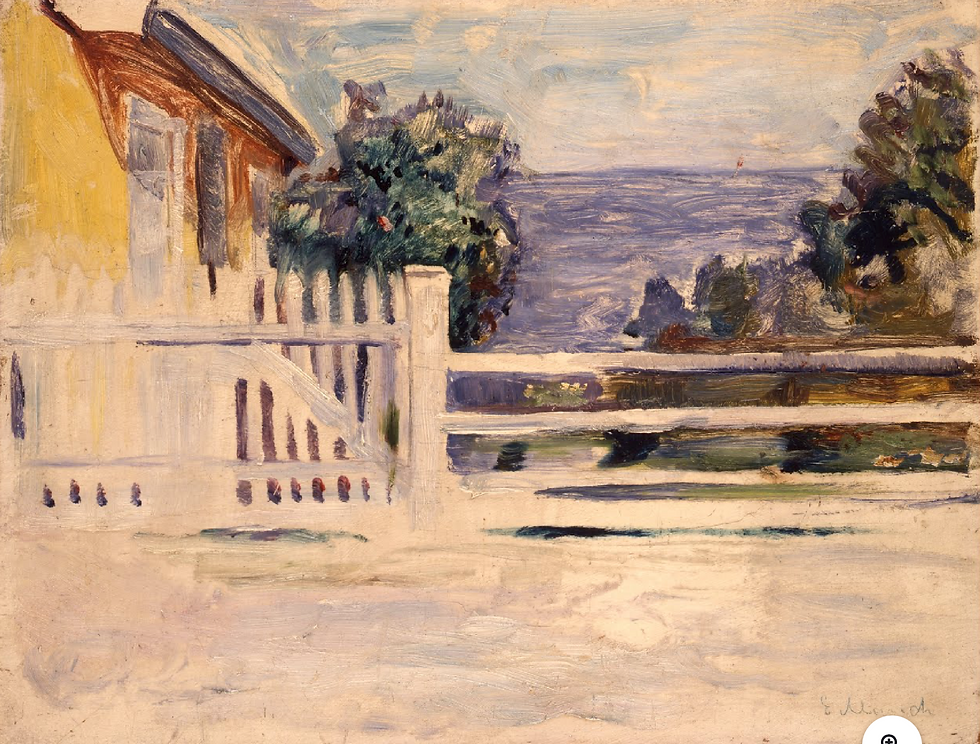
Figure 1: (Munch, 1894)
Edvard Munch, an influential artist of the Expressionism period, left a lasting legacy through his use of textures and nature-inspired movements in his paintings. The collection of artworks in question spans the years 1889 to 1925. Munch's technique involved employing rapid brush strokes to infuse his works with both movement and texture, resulting in a realistic depiction of the scenes. In one of his pieces, the ocean dominates the background, suggesting a personal connection to his own surroundings, which often served as a wellspring of inspiration for his art (Media, 2019).

Figure 2: (Munch, 1894)
In this painting, Munch skillfully depicts the gentle breeze in the sky with smooth brushstrokes and represents the ocean's moving waves using light blues with white accents. The consistent use of these colors throughout the artwork creates a harmonious composition. Munch employs static shapes and a straightforward pattern of rocks, imparting a sense of flowing texture to the scene. This painting also conveys the idea that humans are intertwined with the beauty of nature, highlighting our connection to the natural world (Media, 2019).
Vincent Van Gogh

Figure 3: (Marina & Korolkova, 2019)
Vincent Van Gogh, the renowned artist, crafted numerous textured artworks. He skillfully applied thick layers of oil paint with an expressive touch, resulting in a composition characterized by both a rough texture and a raised surface (BBC, n.d).
When artists apply thick layers of paint on a canvas, it's called impasto. This technique results in a textured surface with visible brushstrokes, providing a tactile and visual experience. The thick brushstrokes follow the contours of the subjects, infusing the painting with a dynamic sense of movement and energy (BBC, n.d).
Figure References
Figure 1: Munch, E. (1894) Edvard Munch, Encyclopædia Britannica. Available at: https://www.britannica.com/biography/Edvard-Munch (Accessed: 06 November 2023).
Figure 2: Munch, E. (1894) Edvard Munch, Encyclopædia Britannica. Available at: https://www.britannica.com/biography/Edvard-Munch (Accessed: 06 November 2023).
Figure 3: Marina, I. and Korolkova, O. (2019) Emotions associated with different textures during touch, Consciousness and Cognition. Available at: https://www.sciencedirect.com/science/article/abs/pii/S1053810018304720#:~:text=Overall%2C%20all%20textures%20were%20associated,fear%2C%20disgust%20and%20anger). (Accessed: 05 November 2023).
References
Media, A. (2019) Textures of nature and their movements by Melissa MacLellan - Google Arts & Culture, Google. Available at: https://artsandculture.google.com/usergallery/4QJS_dF60aSgLA# (Accessed: 05 November 2023).
Media, A. (2019) Textures of nature and their movements by Melissa MacLellan - Google Arts & Culture, Google. Available at: https://artsandculture.google.com/usergallery/4QJS_dF60aSgLA# (Accessed: 05 November 2023).
BBC (no date) Texture and technique - texture - national 5 art and design revision - BBC bitesize, BBC News. Available at: https://www.bbc.co.uk/bitesize/guides/zccx6fr/revision/3# (Accessed: 05 November 2023).
BBC (no date) Texture and technique - texture - national 5 art and design revision - BBC bitesize, BBC News. Available at: https://www.bbc.co.uk/bitesize/guides/zccx6fr/revision/3# (Accessed: 05 November 2023).


Comments