Artists/projects that relate to my project
- Nathan Camilleri
- Jan 4, 2024
- 8 min read

MANUFACTURED LANDSCAPES
BY JENNIFER BAICHWAL
This project unfolds an immersive documentary spotlighting the artistic realm of Edward Burtynsky, a distinguished photographer renowned for capturing vast landscapes transformed by human industry. Burtynsky's lens explores quarries, recycling depots, factories, mines, and dams, transforming civilization's materials and detritus into visually striking and captivating images that elicit questions about ethics and aesthetics, and humans foot print on Earth (Burtynsky, 2014).
Burtynsky skillfully captures the unsettling allure within the artificial landscapes scattered across our planet's surface. Renowned for his photographic exploration of the intricate interplay between humanity and nature, Burtynsky ventures into the concealed recesses of the Earth (Burtynsky, 2014).

Figure 1: (Jacobs, n.d.)
Captured by Burtynsky in 1977, this image showcases a site where discarded car air filters accumulate. The photograph offers an immersive experience, compelling viewers to reflect on human actions. Its visual appeal lies in the balanced composition, where the subjects are intriguingly placed, neither too intrusive nor immediately recognized, prompting viewers to question their nature. As awareness dawns, a sense of caution emerges. The top-down perspective and the frame filled with these air filters enhance the subject's dominance and overall impact. Burtynsky adeptly utilizes technique in both composition and location selection, while the diverse textures, particularly the array of colours, add depth to the narrative (Burtynsky, 2014).

Figure 2: (Jacobs, n.d.)
The photograph showing an abandoned quarry serves as narrative of human impact on the Earth and the footprint we leave behind for our creations. Its strength lies in the portrayal of diverse textures, showcasing the consequences of human intervention. The contrast of colours and the contrast between the man-altered landscape and the sky contribute to a powerful sense of depth within the image. This composition skillfully communicates the profound story of human interaction with the environment and the resulting transformation of natural spaces (Burtynsky, 2014).

Figure 3: (Jacobs, n.d.)
This photograph capturing disposed oil drums further extends the narrative of human influence on the environment. The image remains compelling due to its portrayal of industrial waste and its impact on the Earth. The textured details of the discarded oil drums, combined with the contrast of colors and the surrounding environment, create a vivid depiction. The photograph effectively communicates the consequences of our choices and prompts contemplation on the environmental repercussions of industrial practices (Burtynsky, 2014).
His work serves as a profound inspiration for me. While I resonate with his narrative, I aim to bring a different perspective to similar elements that he captures, elements that are familiar to nearly everyone, myself included. By presenting these common aspects in a fresh light, I aspire to raise awareness and encourage viewers to question their perceptions, fostering a deeper connection with the subjects explored in my own photography.
Terminal Mirage
By David Maisel
In his "Terminal Mirage" project, Maisel purposely hides important details about his pictures, like where and what they show. He doesn't name the Great Salt Lake or its surroundings. Instead, he focuses on making beautiful, abstract colours and designs. Some photos look like landscapes, while others are harder to figure out, they might be old walls or really close-up shots (Maisel, n.d.).
Maisel wants us to first notice the visually pleasing colours and designs in his big prints. But then, he wants us to start asking questions: Who or what made these scenes? The answers aren't clear, and that's okay for Maisel. He's more interested in the discussions and questions his pictures can start, making us think and talk about them.

Figure 4: (Maisel, n.d.)
The image is a bit tricky to figure out, but what really grabs me is the uncertainty, whether it's something people made or not. The artist wants us to wonder about this. What I enjoy are the colours, the arrangement, the unique perspective, and how the colours stand out against each other.
What really inspires me about this project is how the artist captures images that make you stop and think. I want to shoot my photographs in a similar abstract style, aiming for the viewer to pause, engage with the image's narrative, and become aware of the message I want to convey.
Art Works for Change
By Daniel Beltra
Daniel Beltrá takes visually pleasing images of nature. He's a photographer who shows us how beautiful and delicate our world is. He takes images of landscapes and animals, making them look like paintings. When you see his aerial photos, it's like you're flying over icy fields, oceans, and land. But there's also something sad in his images, you can see how the environment is getting damaged and polluted (Beltra, n.d.).
In the animal photographs, Beltrá captures the pain caused by things like oil spills, deforestation, and the changing climate. He's been to lots of places around the world, like the Brazilian Amazon, the Arctic, and icy fields in Patagonia. His images remind us how amazing our planet is, but also how important it is to take care of it (Beltra, n.d.).

Figure 5: (Beltra, n.d.)
In May 2010, ships congregate around the remaining oil platforms near the Deepwater Horizon wellhead. They leave behind oily trails as they navigate through the polluted water (Beltra, n.d.).
This image has a powerful impact, raising awareness about unnoticed events in our surroundings. The presence of the ships provides a sense of scale, emphasizing the magnitude of the oil spill. The photo evokes strong emotions in the viewer, drawing attention to the significant environmental issue. The technical aspects, such as the aerial composition and overall framing, are skill fully executed, contributing to the effectiveness of the image in conveying its message.

Figure 6: (Beltra, n.d.)
In May 2010, a ship navigates through a dense band of oil spilled in the Gulf of Mexico from the Deepwater Horizon wellhead (Beltra, n.d.).
I find inspiration in this project's approach because I, too, want to tell a narrative and raise awareness about the environmental abuse happening around us. Often, these issues go unnoticed, and my goal is to shed light on them, making people more aware of what's happening in our surroundings.
Yangtze - The Long River
By Nadav Kader
Nadav Kander captures images in a time of significant change. His acclaimed series, which earned the prestigious Prix Pictet in 2009, focuses on China undergoing a revolution. While traveling along the Yangtze River, Kander captures serene images of people navigating the challenges of profound transformation. The river itself, serving as China's main artery, symbolizes the ongoing and ever-changing nature of the country (Kander, 2006).

Figure 7: (Kander, 2006)
What really inspires me about this artist's work is how he uses the human element to convey emotional impact. It resonates with my own vision as I aim to showcase the process of how human influence is encroaching on nature. I appreciate how this photographer tells the narrative through his work, capturing the narrative of change and transformation in China.

Figure 8: (Kander, 2006)
I'm also inspired by the atmospheric feel in this artist's images. The gloomy effect adds depth to the narrative, and the graininess enhances a sense of nostalgia. The overall composition is strong, and the images are well exposed. It motivates me to delve deeper into colour grading, aiming for a more impactful aesthetic in my own work.
Landscapes of Conflict
By Richard Misrach
Richard Misrach creates large scale coloured photographs that contemplate human impact on the environment. Integrating environmental awareness with a profound grasp of colour, light, and time, the photographer's renowned series, "Desert Cantos," depicts both the inherent beauty of the desert and the unsettling magnificence of disasters caused by human activities, such as nuclear test sites, animal burial pits, and artificially induced floods and fires (Misrach, Foglia and Riepenhoff, 2020).

Figure 9: (Misrach, Foglia and Riepenhoff, 2020)
While Richard Misrach's art doesn't rely heavily on textures, the narrative resonates with me as the artist effectively communicates the profound human impact on the Earth. This narrative introduces a compelling conflict between the natural world and human activities. Additionally, I appreciate Misrach's ability to utilise simple main subjects, yet craft powerful images through thoughtful composition and processing techniques (Misrach, Foglia and Riepenhoff, 2020).

Figure 10: (Misrach, Foglia and Riepenhoff, 2020)
In general, his images leave a lasting impression, and I'm eager to incorporate some of his techniques into my own work.
Abstractions from Nature
By Keith Dotson
Regrettably, Keith Datson's work lacks a narrative and leans more towards snapshots taken in nature, primarily focusing on textures. Despite the absence of a narrative, I find inspiration in his approach to the subjects he captures. Datson employs various techniques, including the repetition of textures, strong bokeh effects, and the use of a macro lens, all contributing to the creation of powerful images.

Figure 11: (Dotson, n.d.)
In this photograph, the contrast between the whites and blacks catches my eye. The repetition of textures and cracks not only adds depth but also enhances the overall visual appeal, making the image more intriguing.
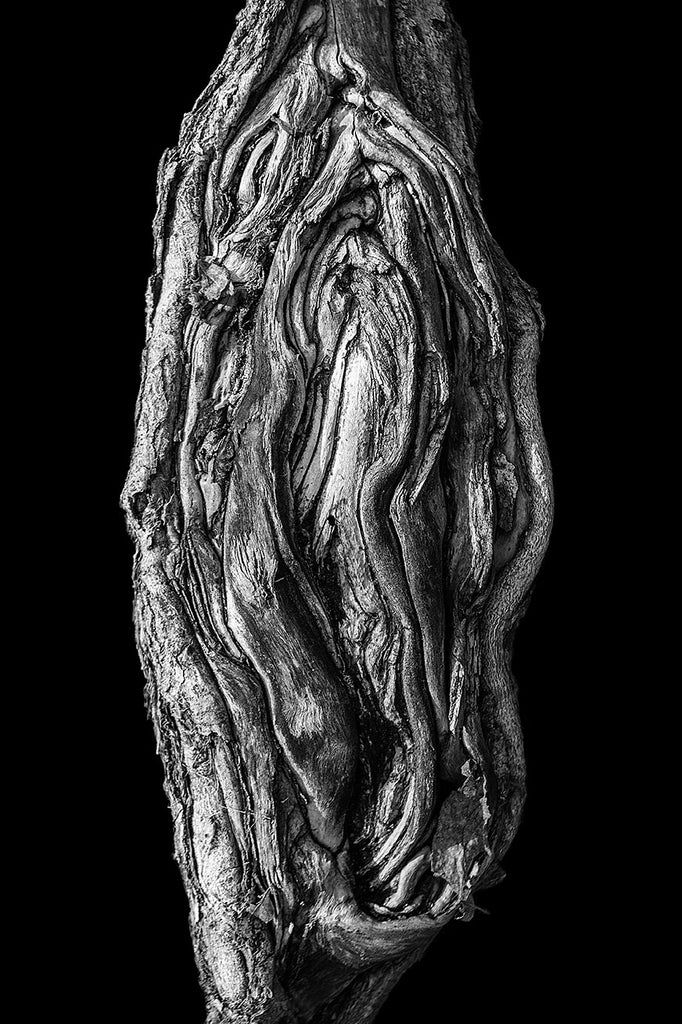
Figure 12: (Dotson, n.d.)
The blown-out blacks and negative space play a crucial role in highlighting the main texture, which is the tree branch. This use of negative space not only contributes to the composition but also enhances the minimal setup, emphasizing the simplicity and elegance of the overall image.

Figure 13: (Dotson, n.d.)
What truly captivates me in this artist's work is the skillful utilisation of black and white. The artist serves as an inspiration for me to consider capturing the image for this project in black and white. I'm eager to continue experimenting and observe how this choice will influence the final results.
Figure References
Figure 1: Jacobs, L. (n.d.). Edward Burtynsky’s extraordinary images of manufactured landscapes | TED Blog. [online] TEDTALK. Available at: https://blog.ted.com/gallery-edward-burtynskys-extraordinary-images-of-manufactured-landscapes/.
Figure 2: Jacobs, L. (n.d.). Edward Burtynsky’s extraordinary images of manufactured landscapes | TED Blog. [online] TEDTALK. Available at: https://blog.ted.com/gallery-edward-burtynskys-extraordinary-images-of-manufactured-landscapes/.
Figure 3: Jacobs, L. (n.d.). Edward Burtynsky’s extraordinary images of manufactured landscapes | TED Blog. [online] TEDTALK. Available at: https://blog.ted.com/gallery-edward-burtynskys-extraordinary-images-of-manufactured-landscapes/.
Figure 4: Maisel, D. (n.d.). David Maisel - Terminal Mirage. [online] LensCulture. Available at: https://www.lensculture.com/projects/476-terminal-mirage [Accessed 26 Jan. 2024].
Figure 5: Beltra, D. (n.d.). Daniel Beltrá – Art Works for Change. [online] Artworks for Change. Available at: https://www.artworksforchange.org/portfolio/daniel-beltra/.
Figure 6: Beltra, D. (n.d.). Daniel Beltrá – Art Works for Change. [online] Artworks for Change. Available at: https://www.artworksforchange.org/portfolio/daniel-beltra/.
Figure 7: Kander, N. (2006). Yangtze, The Long River. [online] Nadav Kander. Available at: https://www.nadavkander.com/works-in-series/yangtze-the-long-river/single.
Figure 8: Kander, N. (2006). Yangtze, The Long River. [online] Nadav Kander. Available at: https://www.nadavkander.com/works-in-series/yangtze-the-long-river/single.
Figure 9: Misrach, R., Foglia, L. and Riepenhoff, M. (2020). Richard Misrach on landscape and meaning. New York: Aperture Foundation Inc.
Figure 10: Misrach, R., Foglia, L. and Riepenhoff, M. (2020). Richard Misrach on landscape and meaning. New York: Aperture Foundation Inc.
Figure 11: Dotson, K. (n.d.). Abstractions from Nature. [online] Keith Dotson Photography. Available at: https://keithdotson.com/collections/abstractions-from-nature.
Figure 12: Dotson, K. (n.d.). Abstractions from Nature. [online] Keith Dotson Photography. Available at: https://keithdotson.com/collections/abstractions-from-nature.
Figure 13: Dotson, K. (n.d.). Abstractions from Nature. [online] Keith Dotson Photography. Available at: https://keithdotson.com/collections/abstractions-from-nature.
References
Maisel, D. (n.d.). David Maisel - Terminal Mirage. [online] LensCulture. Available at: https://www.lensculture.com/projects/476-terminal-mirage [Accessed 26 Jan. 2024].
Beltra, D. (n.d.). Daniel Beltrá – Art Works for Change. [online] Artworks for Change. Available at: https://www.artworksforchange.org/portfolio/daniel-beltra/.
Beltra, D. (n.d.). Daniel Beltrá – Art Works for Change. [online] Artworks for Change. Available at: https://www.artworksforchange.org/portfolio/daniel-beltra/.
Beltra, D. (n.d.). Daniel Beltrá – Art Works for Change. [online] Artworks for Change. Available at: https://www.artworksforchange.org/portfolio/daniel-beltra/.
Beltra, D. (n.d.). Daniel Beltrá – Art Works for Change. [online] Artworks for Change. Available at: https://www.artworksforchange.org/portfolio/daniel-beltra/.
Burtynsky, E. (2014). Edward Burtynsky. [online] Edward Burtynsky. Available at: https://www.edwardburtynsky.com/projects/films/manufactured-landscapes.
Burtynsky, E. (2014). Edward Burtynsky. [online] Edward Burtynsky. Available at: https://www.edwardburtynsky.com/projects/films/manufactured-landscapes.
Burtynsky, E. (2014). Edward Burtynsky. [online] Edward Burtynsky. Available at: https://www.edwardburtynsky.com/projects/films/manufactured-landscapes.
Burtynsky, E. (2014). Edward Burtynsky. [online] Edward Burtynsky. Available at: https://www.edwardburtynsky.com/projects/films/manufactured-landscapes.
Burtynsky, E. (2014). Edward Burtynsky. [online] Edward Burtynsky. Available at: https://www.edwardburtynsky.com/projects/films/manufactured-landscapes.
Kander, N. (2006). Yangtze, The Long River. [online] Nadav Kander. Available at: https://www.nadavkander.com/works-in-series/yangtze-the-long-river/single.
Misrach, R., Foglia, L. and Riepenhoff, M. (2020). Richard Misrach on landscape and meaning. New York: Aperture Foundation Inc.
Misrach, R., Foglia, L. and Riepenhoff, M. (2020). Richard Misrach on landscape and meaning. New York: Aperture Foundation Inc.


Comments